Choosing the right 660nm 850nm Red Light Therapy device can feel simple until specifications, safety documents, and market requirements appear. Global buyers often compare wavelength claims, irradiance, treatment areas, timers, and power supplies. A bright panel is not automatically a better panel. That assumption deserves closer review.
This guide introduces seven practical tips for evaluating products across different countries and purchasing environments. It considers how 660nm visible red light and 850nm near-infrared light are described in technical documents. It also examines measurement methods, thermal control, eye protection, electrical certifications, and supplier transparency. Buyers should request test reports, user instructions, warranty terms, and clear information about intended use. Photographs alone cannot confirm performance. Neither can impressive marketing language.
Real purchasing experience shows that small details often create major problems. A plug may not match local sockets. A cooling fan may become distracting in a quiet clinic. Calibration data may be missing. These issues can delay installation and weaken customer trust. Reliable suppliers explain limitations instead of promising universal results. They distinguish wellness support from medical treatment and encourage appropriate professional advice. Evidence remains uneven across applications, so cautious wording matters. It is tempting to treat every study as proof. That would be careless. Buyers should compare independent research, product testing, and regulatory expectations before making decisions. The following tips provide a practical framework for asking better questions, reducing avoidable risk, and selecting equipment with greater confidence in international markets.
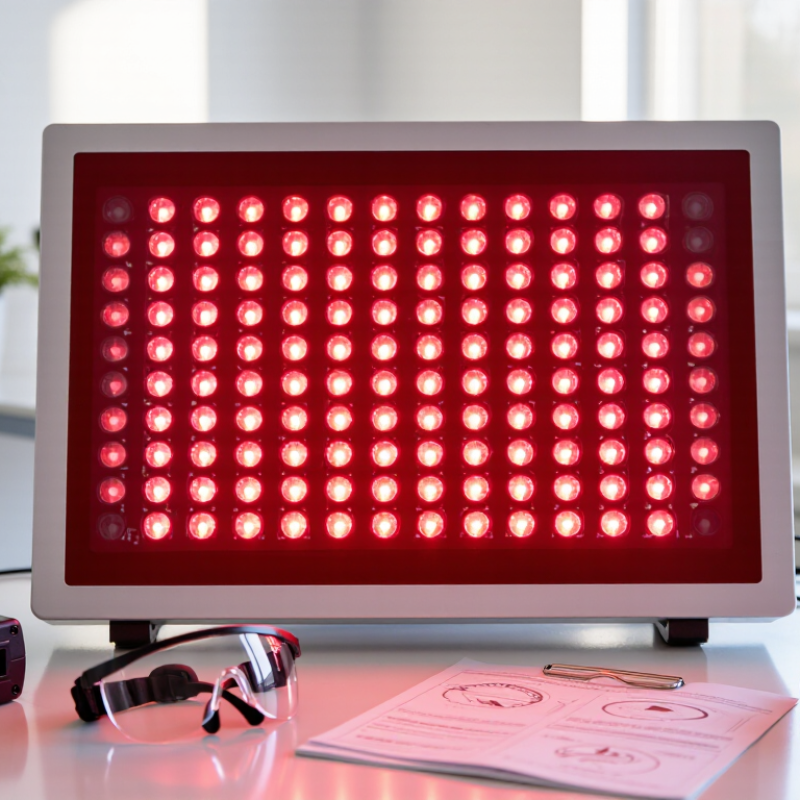
660nm red light is visible; 850nm light is near-infrared. The human eye barely detects 850nm. Both wavelengths support photobiomodulation research, but they do not behave identically. Red light usually interacts with shallower tissue. Near-infrared light can reach deeper structures, although penetration varies with skin tone, tissue thickness, angle, and device output.
Dose matters more than wavelength alone. WALT photobiomodulation guidance commonly discusses irradiance ranges near 5–50mW/cm² and energy doses around 4–10J/cm² for selected applications. These are reference values, not universal prescriptions. A 100mW/cm² device delivers energy quickly. Heat and excessive exposure may increase discomfort. Buyers should request measured irradiance, wavelength tolerance, treatment distance, and thermal test results. Marketing diagrams are not enough.
Look for independent measurements. A spectrometer report can confirm whether “660nm” actually centers near 660nm. IEC 62471 photobiological safety testing helps assess optical risks. The Global Wellness Institute reported a 6.3 trillion-dollar global wellness economy in 2023, showing strong market momentum, but market growth does not prove clinical effectiveness. I have seen buyers compare LED counts instead of delivered dose. That shortcut is tempting, but incomplete. A practical evaluation should record skin distance, session time, surface temperature, and user response. Results can be inconsistent. That is normal.
660nm and 850nm red light therapy use different parts of the light spectrum. The 660nm wavelength is visible red light. It mainly reaches the skin and upper tissues. Some studies suggest it may support cellular energy production and skin repair. Results can vary with dose, distance, skin type, and treatment consistency.
The 850nm wavelength is near-infrared and cannot be seen. It generally travels deeper than 660nm light, making it relevant to muscles, joints, and other underlying tissues. Users may feel little or no warmth. That does not prove the device is working. I have found that comfort can be misleading, while excessive heat may signal poor distance control. Buyers should check measured irradiance, treatment area, timer accuracy, and independent safety information.
Use protective eyewear when the instructions require it, especially with bright 660nm LEDs. Start with short sessions and observe redness, discomfort, or unusual sensitivity. Keep the panel at its stated distance. More exposure is not automatically better. People taking light-sensitive medication, managing eye conditions, or receiving medical treatment should ask a qualified clinician before use. Global buyers should also review electrical certification, plug compatibility, warranty terms, and return policies. Marketing language often sounds more certain than the evidence. A careful buyer should question claims about weight loss, disease treatment, or guaranteed results. The science is promising, but it is not perfectly settled.
660nm 850nm Red Light Therapy: 7 Tips for Global Buyers
Key Specifications for Evaluating Red Light Therapy Devices
When I evaluate red light therapy devices, I check wavelength accuracy before appearance. A reliable unit should clearly identify 660nm red light and 850nm near-infrared light. Ask whether measurements come from independent testing or factory estimates. Numbers without evidence deserve caution. Very high irradiance is not automatically better. Confirm irradiance in mW/cm² at a stated distance, such as 15 centimeters. Then calculate dose using exposure time and treatment distance. A simple timer helps users repeat sessions consistently.
Coverage matters during practical use. Inspect the treatment area, LED spacing, and beam uniformity. Bright spots can leave uneven exposure across the skin. Check whether the device warms noticeably after ten minutes. Heat may indicate poor ventilation, although temperature alone does not prove performance. Controls should show wavelength selection, intensity, timer settings, and error alerts. Keep operation simple. Complex menus often reduce consistent use. I once overlooked cable length during evaluation, and the device became awkward beside a treatment chair.
Global buyers should verify input voltage, plug compatibility, electromagnetic compatibility, and photobiological safety documentation. Look for clear user instructions, cleaning guidance, contraindication warnings, and contact information for technical support. Independent laboratory reports are more useful than vague compliance language. Warranty terms should state coverage periods and service locations. Device results can vary between users. Avoid promises of guaranteed outcomes. A careful specification sheet still cannot replace professional medical advice when symptoms or health conditions are involved.
Key specifications for evaluating red light therapy devices should be verified at the actual treatment distance, not only from nominal product ratings.
Illustrative calculation based on a verified irradiance of 50 mW/cm²: fluence (J/cm²) = irradiance (W/cm²) × treatment time (seconds). The chart applies the same dose calculation to 660nm red light and 850nm near-infrared light; it is not a clinical recommendation.
Confirm whether the device uses approximately 660nm red light, 850nm near-infrared light, or both. Ask for measured spectral output and bandwidth.
Check irradiance in mW/cm² at the recommended skin distance. A reading at the LED surface may not represent real treatment conditions.
Use the delivered energy density in J/cm² together with treatment time. The timer should support repeatable sessions.
Compare the illuminated treatment area, LED distribution, and uniformity. A high output at the center may not mean uniform coverage.
Review surface temperature, cooling design, duty cycle, and user safeguards, especially for close-contact or enclosed devices.
For international purchasing, verify input voltage, frequency, plug configuration, adapter ratings, and applicable electrical safety documentation.
Request test conditions, measurement distance, calibration details, spectral data, user instructions, warranty terms, and shipment documentation.
Safety begins with realistic expectations. A 660nm wavelength commonly targets superficial skin areas, while 850nm near-infrared light may reach deeper tissues. The effects depend on irradiance, distance, exposure time, and individual health. More power is not automatically better. That assumption deserves caution.
Choose a device with clear technical data, including wavelength tolerance, output measurements, timer settings, and electrical safety information. Global buyers should check local import, labeling, and electrical requirements before purchase. Standards differ between countries. Follow the supplied instructions, and avoid staring directly at bright LEDs. Wear suitable eye protection when the manual recommends it. Keep the device away from water and damaged cables.
Clean and dry the treatment area. Start with a short session at the manufacturer’s suggested distance, perhaps several minutes, then observe redness, heat, or discomfort. A patch test can reveal unexpected sensitivity. Stop if burning, swelling, persistent irritation, or vision changes occur. People using photosensitizing medicines, managing eye conditions, or treating serious health problems should ask a qualified clinician first. Pregnancy and chronic conditions also deserve professional advice. Red light therapy is not a substitute for diagnosis or prescribed care. I would not promise identical results across users; skin type, sleep, medication, and consistency can change the experience. Keep a simple log of duration, distance, and skin response. Small records often expose mistakes that memory misses.
660nm and 850nm devices attract global buyers, but wavelength alone does not prove quality. In my purchasing checks, I examine the test report, not only the sales page. IEC 62471 evaluates photobiological safety, including retinal and skin exposure risks. Ask for the complete report, test distance, exposure time, and laboratory identity. A printed certificate can look convincing and still lack traceability.
Tip 1: Verify certification before comparing prices. For medical applications, review the destination market’s rules and intended-use claims. ISO 13485 certification may show controlled manufacturing, but it does not automatically approve every product. Grand View Research estimated the global light therapy market at about USD 1.2 billion in 2023, with continued growth forecast through 2030. Such growth also attracts weak documentation. I remain cautious when a supplier promises clinical results without peer-reviewed evidence.
Tip 2: Request measurable quality data. Check irradiance in mW/cm², wavelength tolerance, heat control, timer accuracy, and electrical safety testing. A useful report should show readings across the treatment area, not one perfect center point. Shipping deserves equal attention. Confirm plug type, voltage, customs documents, packaging drop tests, and replacement procedures.
Tip 3: Test support before payment. Send technical questions and measure response quality. Can the team explain warranty limits and spare-part availability? In real projects, unclear after-sales support causes more delays than transit time. That lesson is easy to overlook.