Buying a toy hauler across borders is more complex than choosing a floor plan and color. Buyers must assess towing capacity, road dimensions, climate, service access, and import requirements. A polished brochure cannot answer every question.
The market is substantial. The RV Industry Association reported 313,174 wholesale RV shipments in the United States during 2023, across towable and motorized categories. Its 2024 Industry Profile also shows strong RV ownership and continued consumer interest in outdoor travel. However, toy hauler figures are rarely separated clearly. That gap matters for global buyers.
International market estimates provide useful direction, but their definitions often differ. Grand View Research identifies recreational vehicles as a growing global market, influenced by leisure travel, flexible living, and outdoor recreation. Still, forecasts are not guarantees. Exchange rates, shipping costs, local taxes, and dealer support can change the real purchase price quickly.
A reliable buying decision begins with evidence. Measure your vehicle’s rated towing capacity, not its optimistic brochure promise. Check the toy hauler’s gross vehicle weight rating, payload, hitch load, ramp capacity, and axle specifications. Picture the loading process: motorcycle tires on a wet ramp, limited clearance, and several hours of travel.
This guide presents ten practical toy hauler buying tips for buyers in different regions. It considers construction quality, ventilation, electrical systems, warranty coverage, spare parts, and resale value. Some recommendations may not fit every country. That is the point. Local roads, weather, and regulations can expose assumptions that looked reasonable at the dealership. Industry reports help establish context, but careful inspection and qualified local advice remain essential.
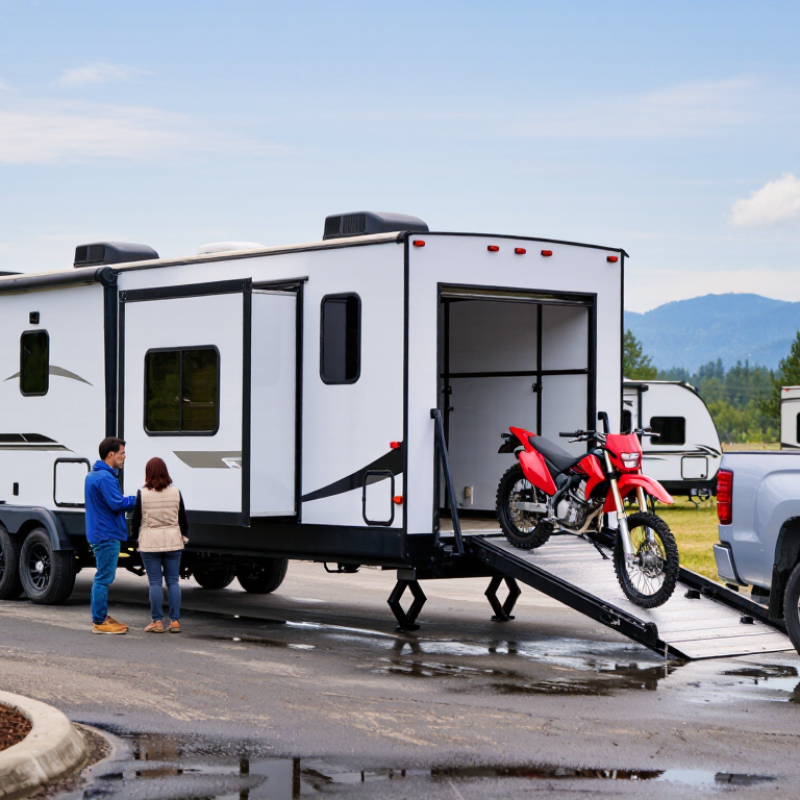
Before comparing layouts, define exactly what you will carry. A small trail motorcycle needs different space than an all-terrain vehicle. Measure each item’s length, width, height, and wet weight. Allow room for ramps, helmets, tie-downs, and maintenance tools. I learned that “fits inside” can still mean awkward loading.
Your travel requirements matter as much as cargo. List expected road surfaces, weather conditions, trip length, and campsite access. For cross-border travel, check local rules before purchasing. Requirements can differ between neighboring countries. Confirm permitted dimensions, axle limits, lighting, registration, and insurance with official transport authorities. Climate also deserves attention. Heat, snow, and coastal salt can affect seals, flooring, and ventilation. Small details matter.
Estimate how often you will haul recreational equipment, not only where you will sleep. Include personal luggage, water, spare parts, and approved fuel containers within the payload calculation. Many buyers focus on sleeping space and overlook loading clearance. I would challenge that choice. A shorter trailer may suit narrow roads, yet it may leave no changing space. Write a realistic one-week packing list, then test the loading sequence with your actual equipment. If the ramp angle feels unsafe or tie-down points are difficult to reach, reconsider the layout. Perfect plans are rare. Practical testing is better.
| No. | Buying Tip | Key Questions to Answer | Practical Specification or Benchmark | Why It Matters for Global Buyers | Priority |
|---|---|---|---|---|---|
| 1 | Match the garage to the actual toys | What are the combined length, width, height, and weight of the motorcycles, ATVs, bicycles, or watercraft? | Measure each toy with accessories installed. Allow approximately 300–600 mm of extra length and at least 150 mm of side clearance for loading and tie-down access. | Vehicle dimensions and loading methods vary by country. Accurate measurements reduce the risk of unusable garage space or difficult customs modifications. | High |
| 2 | Calculate payload, not just garage capacity | Can the trailer carry the toys, fuel, water, luggage, tools, passengers, and optional equipment safely? | Payload equals the certified maximum loaded mass minus the empty operating mass. Include toy weight, typically 150–450 kg for motorcycles or small ATVs, plus all travel cargo. | Overloading can reduce braking performance, damage suspension components, and violate road regulations in the destination country. | High |
| 3 | Check tow-vehicle compatibility | What are the tow vehicle’s legal towing capacity, maximum combined mass, hitch rating, and vertical load limit? | Keep the fully loaded trailer below the tow vehicle’s rated capacity. A commonly recommended starting point is a 10–15% trailer nose weight, subject to local regulations and manufacturer limits. | Ratings, hitch systems, and licensing categories differ internationally. The lowest applicable limit controls the legal combination. | High |
| 4 | Choose the right layout for travel duration | Will the toy hauler be used for weekend trips, extended touring, seasonal travel, or semi-permanent living? | For extended trips, consider sleeping capacity for 2–6 people, a separate bathroom, a kitchen, insulated living space, and storage for at least 3–7 days of supplies. | Long-distance travel requires more water, power, food storage, and climate control than short recreational trips. | High |
| 5 | Verify road and access dimensions | Can the unit fit local roads, parking areas, ferry decks, campsites, tunnels, and storage facilities? | Record the loaded height, width, length, turning radius, and ground clearance. Many touring trailers are approximately 2.4–2.6 m wide and 7–12 m long, depending on configuration. | Road widths, bridge clearances, parking standards, and ferry restrictions vary significantly between regions. | High |
| 6 | Plan power and climate-control needs | Will you rely on campsite electricity, generator power, solar charging, or a mixed system? | Common systems include 12 V auxiliary power, 100–400 Ah battery capacity, 200–800 W of solar input, and shore-power compatibility. Confirm the local electrical voltage and frequency. | Electrical standards can differ between countries. Adapters alone cannot safely correct an incompatible voltage or frequency. | High |
| 7 | Size water and waste systems realistically | How long will the trailer operate away from water, drainage, and service facilities? | A practical starting range is 100–250 L for fresh water and 80–200 L for combined wastewater storage, depending on occupancy and travel style. | Water weight adds approximately 1 kg per liter, so larger tanks directly affect payload, axle loading, and fuel consumption. | Medium |
| 8 | Inspect loading and tie-down safety | Can the toys be loaded safely, and are the tie-down points rated for their weight and movement? | Look for a ramp rated above the heaviest toy, non-slip flooring, wheel chocks, multiple rated anchor points, and clear separation between living and fuel-storage areas. | Loading procedures and safety equipment should suit local road conditions, terrain, and regulations for transporting recreational vehicles. | High |
| 9 | Review serviceability and spare parts | Can essential components be repaired or replaced in the countries where the trailer will travel? | Prioritize commonly available tires, bearings, lighting components, brake parts, plumbing fittings, and electrical connectors. Carry basic spare parts and service documentation. | Specialized components may have long lead times or require import procedures far from the original sales market. | Medium |
| 10 | Confirm legal, insurance, and import requirements | Does the trailer meet registration, lighting, braking, emissions, safety, and temporary-import rules in every intended destination? | Check the required trailer category, maximum axle loads, braking system, lighting configuration, VIN or chassis documentation, insurance, and driving-license requirements before purchase. | Compliance requirements can determine whether the trailer may be registered, towed, insured, or temporarily imported. | High |
Planning figures are general reference ranges. Always confirm the certified ratings, legal limits, and technical requirements that apply in the country of registration and each destination country.